Short answer
Sleep enough comes first: short sleep clearly slows reactions. Then cut your device’s delay with a wired mouse and a fast screen, and do a few warm-up tries. Caffeine helps, and research shows it clearly in tired people. Practice makes you better at a game. Simple reaction tests change little with practice.
Warning: This is not a medical test
This page explains research, it isn’t medical advice. If your reactions have been getting slower for no clear reason, see a doctor. Sudden weakness or numbness on one side, sudden confusion or trouble speaking can be a stroke: call emergency services at once.
Step 1: measure where you are
Test it now
Reaction time test
Do 5 tries and note your median. Test again on the same device after each change, because every device adds its own delay.
Where the time goes
Every time you measure has two parts: yours and your device’s.
- The screen shows the change. A 60 Hz screen can take up to 17 ms.
- You see it and decide. This is most of your time.
- Your finger moves and presses.
- The mouse or keyboard and the computer register the press.
In a lab study of 1,469 adults, the average was 231 ms. Of that, 18 ms came from the lab’s screen and mouse (Woods and others, 2015). Home setups can add more. A bench test of online test websites on ordinary computers found times about 80 ms too slow on average (Anwyl-Irvine and others, 2021). So compare your times only with your own times on the same device.
What works, ranked by the evidence
| What you change | How much it helps | How sure the research is |
|---|---|---|
| Sleep enough | A lot, if you’re short of sleep | Strong |
| A faster setup | Up to tens of milliseconds | Strong (it’s measurable) |
| Caffeine | Clear in tired people | Moderate |
| Warm-up and exercise | Small | Moderate |
| Practice and games | Big for a game or sport, little on a simple reaction test | Mixed |
Sleep enough
A review of 70 studies looked at a night or more without sleep. It hit simple attention and reaction tests harder than other kinds of thinking (Lim and Dinges, 2010).
- A night for 2 weeks: as bad as up to 2 nights without sleep (Van Dongen 2003)
- 6 hours or less
- Awake: some tests as bad as at 0.05% blood alcohol (Williamson 2000)
- 17–19 hours
The worrying part: people on short sleep didn’t feel much sleepier as the weeks went on. Their reactions kept getting worse all the same (Van Dongen and others, 2003). So test yourself rested, and don’t trust how alert you feel.
Take the delay out of your setup
These don’t make you faster, but they cut the time your device adds, in a game as well as in the test.
- Use a wired mouse or keyboard. Some wireless mice and keyboards add more delay.
- Use your screen’s highest refresh rate. A 144 Hz screen shows a change sooner than a 60 Hz one. Check yours in the refresh rate test.
- Turn on game mode on a TV, if it has one. It is meant to cut the TV’s picture delay.
- Close other apps and tabs, so the computer isn’t busy when you press.
- Check your mouse in the mouse polling rate test.
The typical delays of each part are in what your device adds.
Caffeine helps, especially when you’re tired
A review found that low to moderate amounts of caffeine, about 40 to 300 mg, improve alertness and reaction time (McLellan and others, 2016). A review of studies in people who had lost sleep found a large effect on reaction time (Irwin and others, 2020). A 12-ounce cup of brewed coffee has about 113 to 247 mg.
The US Food and Drug Administration says about 400 mg a day isn’t usually linked to harm in healthy adults, but people differ. It advises against energy drinks for children and teens (FDA). Caffeine doesn’t replace sleep.
Warm up
- A few practice tries first. Most people get faster over their first few runs of a test, then level off.
- Moderate exercise before you play. In a review of studies, a single bout of exercise sped up reactions slightly. Moderate effort helped more than very light or very hard effort (McMorris and Hale, 2012). The effect was small.
Practice: what it can and can’t do
What gets better
With practice
Knowing what to look for, where to aim and what to do next. In a game or sport, that makes you react sooner, because you decide faster. Our aim trainer trains this kind of skill.
What barely changes
Simple reaction time
Pressing as fast as you can when one light changes. Sleep researchers use one such test, the psychomotor vigilance test, partly because people show no sign of learning it with repeats (Basner and Dinges, 2011).
Video games: a review of many studies found that action games improved attention and spatial skills. In training studies the effect was modest (Bediou and others, 2018). The authors also found that published results looked better than the full research does. Play because you enjoy it, not as a cure for slow reactions.
What slows you down
- Tiredness and lost sleep, as above.
- Alcohol. It slows attention and control of movement.
- Distraction. Using a phone while driving slowed drivers’ reactions by about a quarter of a second, in a review of 33 studies (Caird and others, 2008). Hands-free phones were no better.
- Age. Simple reaction time slows by about half a millisecond a year in adults. Most of that is in moving the hand, not in seeing (Woods and others, 2015).
How fast can anyone react?
World Athletics treats a start less than 0.100 seconds (100 ms) after the gun as a possible false start. Our test uses the same limit: it leaves out presses under 100 ms as guesses.
Test again
Retest at the same time of day, on the same device, after a normal night’s sleep.
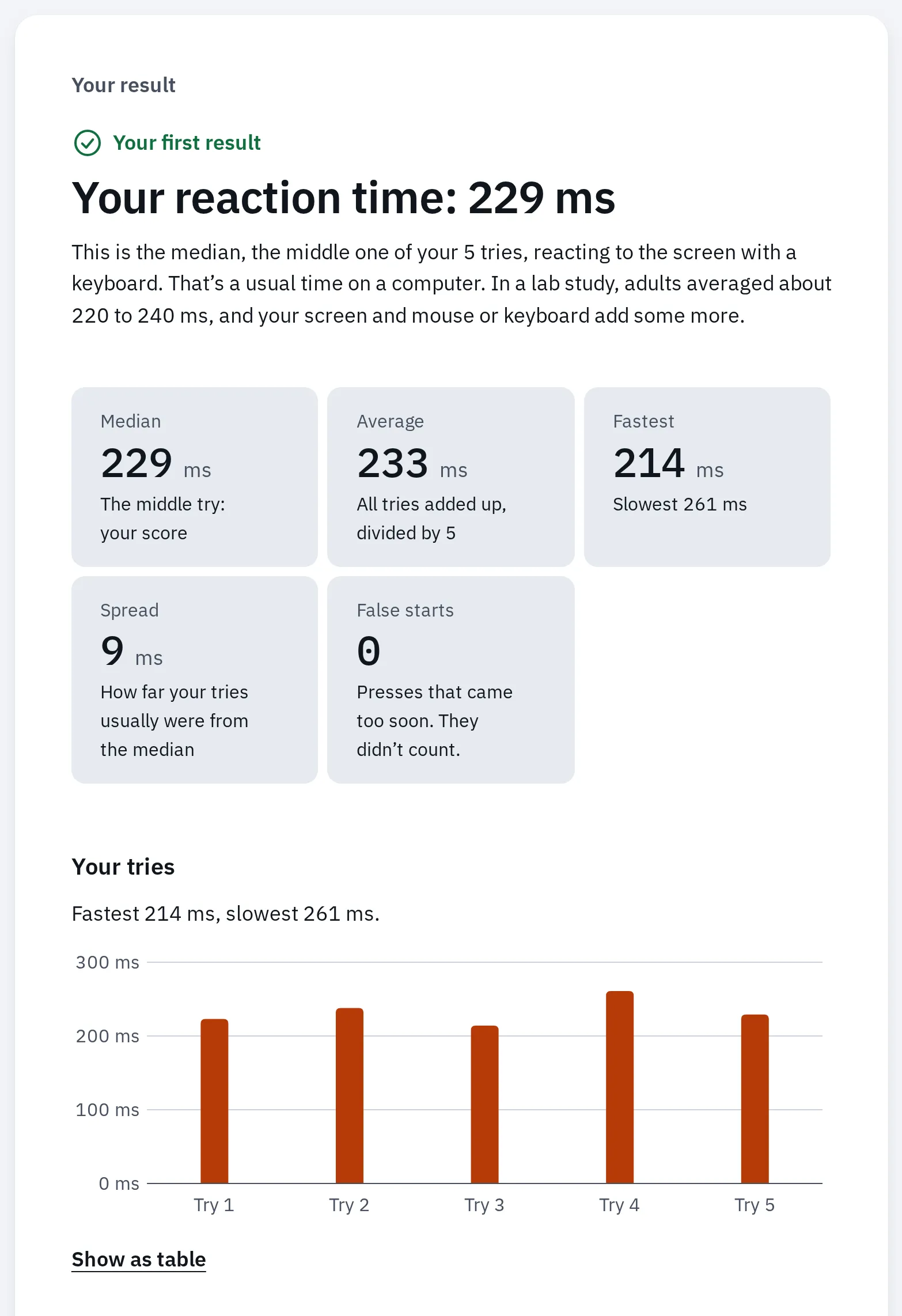
A result in our test (5 tries sent by a test script). Compare the median from one run to the next: one slow try barely changes it.
Questions people ask
Can you train your reaction time?
A little. Most people get faster over their first few runs, then level off. Practising a game or sport helps much more, because you learn what to look for and decide faster.
Why is my reaction time so slow today?
The most common causes are short sleep, being tired or distracted, and a slower device. A phone’s touch screen or a TV outside game mode adds a lot. Test again rested, on the same computer.
What is a good reaction time?
See normal times by age in our reaction time test. Your device adds its own delay, so compare with your own earlier times.
Do energy drinks improve reaction time?
Their caffeine can, especially when you’re tired. Check how much caffeine is in the can. The FDA’s figure of about 400 mg a day is for most healthy adults, and it advises against energy drinks for children and teens.
Does age affect reaction time?
Yes, slowly: about half a millisecond a year in adults, mostly in moving the hand. Our test page has the averages by age.