Short answer
Allegro means fast and bright: about 120 to 156 BPM (beats per minute). Andante is a walking pace, about 76 to 108 BPM. Adagio is slow, about 66 to 76 BPM. The words describe a character, not an exact speed, so sources give different numbers. If the music prints a number, play that number.
Tempo markings chart
From slowest to fastest. The BPM ranges are the ones our metronome uses to name your tempo. Each link opens it at a speed in the middle of the range: press Start to hear it.
| Marking | BPM | Hear it |
|---|---|---|
| Grave: very slow and solemn | 20–39 | 30 BPM |
| Largo: slow and broad | 40–59 | 50 BPM |
| Larghetto: fairly slow | 60–65 | 63 BPM |
| Adagio: slow and calm | 66–75 | 70 BPM |
| Andante: at a walking pace | 76–107 | 92 BPM |
| Moderato: at a moderate speed | 108–119 | 112 BPM |
| Allegro: fast and bright | 120–155 | 138 BPM |
| Vivace: lively and fast | 156–175 | 166 BPM |
| Presto: very fast | 176–199 | 188 BPM |
| Prestissimo: as fast as possible | 200 and up | 208 BPM |
The BPM counts quarter notes, unless the music says otherwise (see below).
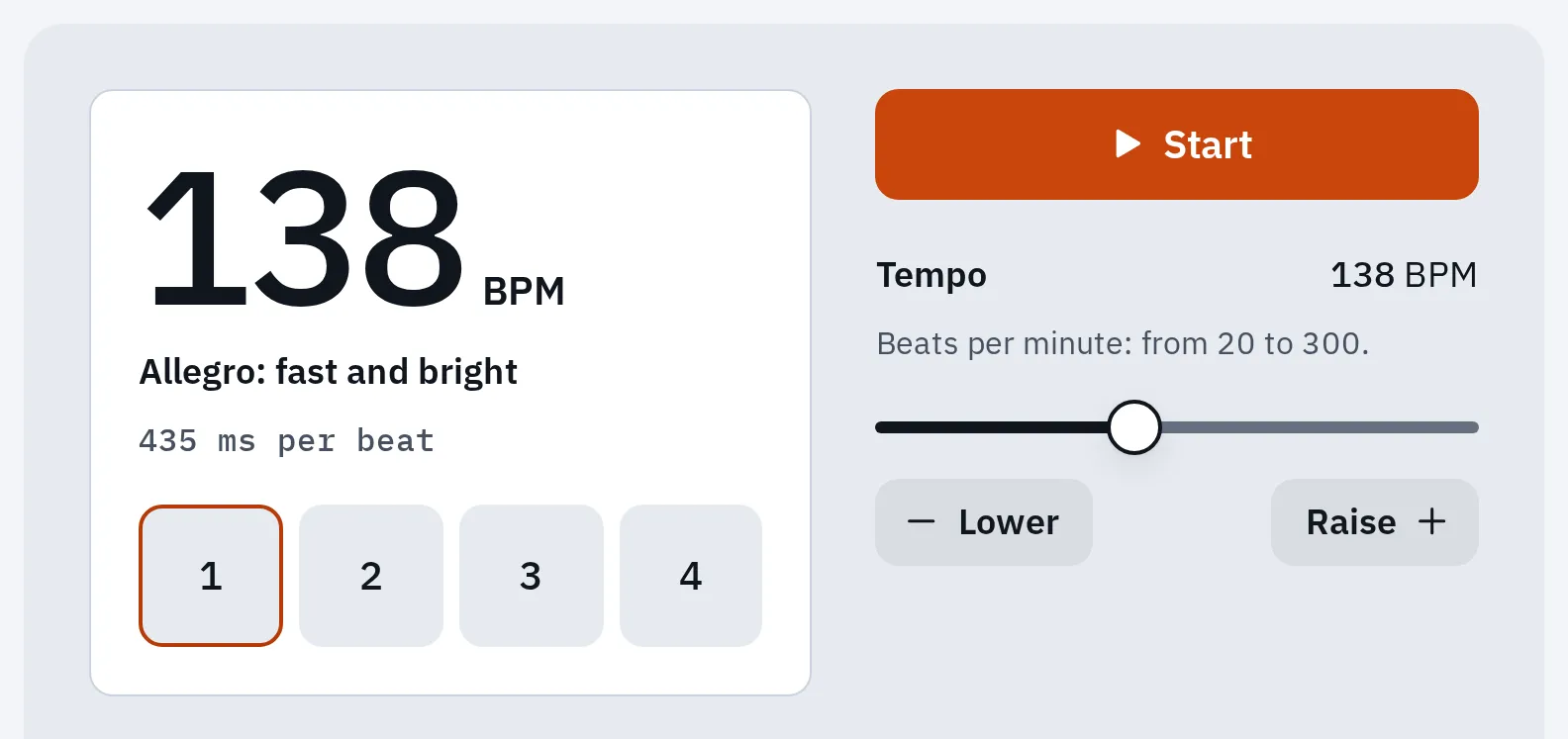
The metronome names the marking for the tempo you set: 138 BPM is Allegro.
Test it now
Metronome
Set any tempo and press Start. It clicks at that speed and names the marking for it.
More tempo words
These words overlap the main ranges. Our metronome doesn’t show them, so the ranges here come from Wikipedia’s tempo list.
| Marking | About (BPM) | Hear it |
|---|---|---|
| Lento: slow | 40–60 | 50 BPM |
| Adagietto: a little faster than adagio | 46–80 | 70 BPM |
| Andantino: usually a little faster than andante | 80–108 | 96 BPM |
| Allegretto: moderately fast | 112–120 | 116 BPM |
| Allegro moderato: nearly allegro | 116–120 | 118 BPM |
| Molto allegro: faster than allegro | 124–156 | 144 BPM |
Why the charts disagree
The Italian words are older than the metronome. Johann Maelzel brought out the metronome in the early 1800s, and only then did composers start to write BPM numbers. Wikipedia calls the BPM values “very rough approximations”, and the meaning of some words has changed over time.
Three sources show how wide the gaps are:
| Marking | Wikipedia | Wittner metronome manual | Symphony Nova Scotia |
|---|---|---|---|
| Adagio | 44–66 | 66–76 | 55–65 |
| Andante | 56–108 | 76–108 | 73–77 |
| Moderato | 108–120 | 108–120 | 86–97 |
| Allegro | 120–156 | 120–168 | 109–132 |
| Presto | 168–200 | 168–200 | 168–177 |
So “What BPM is allegro?” has no single answer. Most charts start it near 120 BPM. Where it ends depends on who wrote the chart.
How to use a tempo marking
- The tempo word, such as Allegro
- The metronome mark: a note, an equals sign and the BPM
- A change of tempo, such as rit. (slow down), with a dashed line for how long it lasts
Where the tempo is written on sheet music.
If there is a number, play the number
A mark such as ♩ = 120 means 120 quarter notes a minute. Type it into the metronome and play along. Use the number for the speed. Use the word as a guide to the character of the music.
Check which note gets the beat
The note before the equals sign is the one the metronome clicks. Beethoven marked the first movement of his 5th Symphony “Allegro con brio”, half note = 108. That is 108 half notes, or 216 quarter notes, a minute. Set 108 BPM and count each click as a half note. The metronome calls 108 Moderato, because it names the tempo for quarter notes.
In 6/8 time, look at the note in the mark. Our metronome clicks each eighth note in 6/8.
- The mark counts eighth notes: set the printed number.
- The mark counts dotted quarter notes: set three times the number. Our metronome goes up to 300, so this works up to 100.
- Faster than 100 dotted quarters: choose 2/4 instead, set the printed number, and count each click as a dotted quarter.
If there is only a word, start in the middle
- Open the metronome at the middle of the range in the chart above.
- Play a few bars. Listen to the fastest notes: they must still sound clear.
- Change the tempo a few BPM at a time. Aim for the character of the word, such as walking for Andante or lively for Vivace.
- Write your number on the music, so you play it the same way next time.
Practise slower than the marking
Learn a hard part well below the marked tempo, then speed up in small steps. The metronome’s tips explain how.
Examples: composers don’t follow the charts
Beethoven was one of the first composers to write metronome marks. Two of his marks fall outside most charts. So use the printed number for speed, and the word for character:
Conductors still argue about some of his marks. Treat a chart as a starting point and the printed number as the plan.
Words that change the tempo
These appear during a piece, often shortened. Some are followed by a dashed line that shows how long the change lasts.
| Word | Short form | What to do |
|---|---|---|
| Accelerando | accel. | Speed up little by little |
| Ritardando | rit. or ritard. | Slow down little by little |
| A tempo | Go back to the tempo from before the change | |
| Più mosso | More movement: faster | |
| Meno mosso | Less movement: slower | |
| Molto | Very, as in Molto allegro | |
| Ma non troppo | But not too much, as in Allegro ma non troppo |
Questions people ask
What BPM is allegro?
Most charts put allegro at about 120 to 156 BPM. Some stretch it to 168. Our metronome calls 120 to 155 BPM allegro. Try 138 BPM, the middle of that range.
Is andante fast or slow?
In between. Andante means “walking”, so it is a relaxed, moderate pace: about 76 to 108 BPM. Andantino usually means a little faster than andante, but some musicians read it as a little slower.
What is the slowest and the fastest tempo marking?
The slowest common words are Grave and Larghissimo: under about 40 BPM. The fastest is Prestissimo: 200 BPM and above.
Why are tempo markings in Italian?
Many leading composers of the 17th century were Italian, and tempo words were first used widely then. Composers in France, Germany and England often wrote tempo words in their own language too.
How do I find the BPM of a song?
Tap along with the music on our tap BPM counter. It shows the BPM and the matching tempo marking.