Short answer
A tuning is the set of notes your six open strings play. Standard tuning is E A D G B E, from the thickest string to the thinnest. Open D is D A D F♯ A D. Open G is D G D G B D. DADGAD is D A D G A D. Half step down lowers every string by one fret. The chart shows which strings to turn.
Guitar tunings chart
♭ means flat: one fret lower. ♯ means sharp: one fret higher. The number after a note, as in E2, is its octave: E3 is the same note, one octave higher.
Notes go from the 6th string (thickest) to the 1st (thinnest). Tap the notes to open our tuner set to that tuning. “Down 2” means two frets lower: loosen the string until it plays the note two frets below.
| Tuning | Notes | Strings to change from standard |
|---|---|---|
| Standard | E A D G B E | None |
| Drop D | D A D G B E | 6th down 2 |
| Half step down | E♭ A♭ D♭ G♭ B♭ E♭ | All six down 1 |
| D standard (whole step down) | D G C F A D | All six down 2 |
| Drop C | C G C F A D | 6th down 4, the rest down 2 |
| Open D | D A D F♯ A D | 6th, 2nd and 1st down 2; 3rd down 1 |
| Open G | D G D G B D | 6th, 5th and 1st down 2 |
| DADGAD | D A D G A D | 6th, 2nd and 1st down 2 |
| Open E | E B E G♯ B E | 5th and 4th up 2; 3rd up 1 |
| Open C | C G C G C E | 6th down 4; 5th and 4th down 2; 2nd up 1 |
| 12-string | E A D G B E in pairs | The four thick pairs get a partner an octave higher; B and E pairs match |
Hear the tunings
Tap a string to hear its note, or strum to hear all six together. The strings with an orange edge are the ones that differ from standard tuning.
Standard
Open D
Open G
DADGAD
Change tuning with the tuner
Each tuner link in the chart opens our guitar tuner already set to that tuning. Its string buttons show the new notes, and you can press one to hear it.
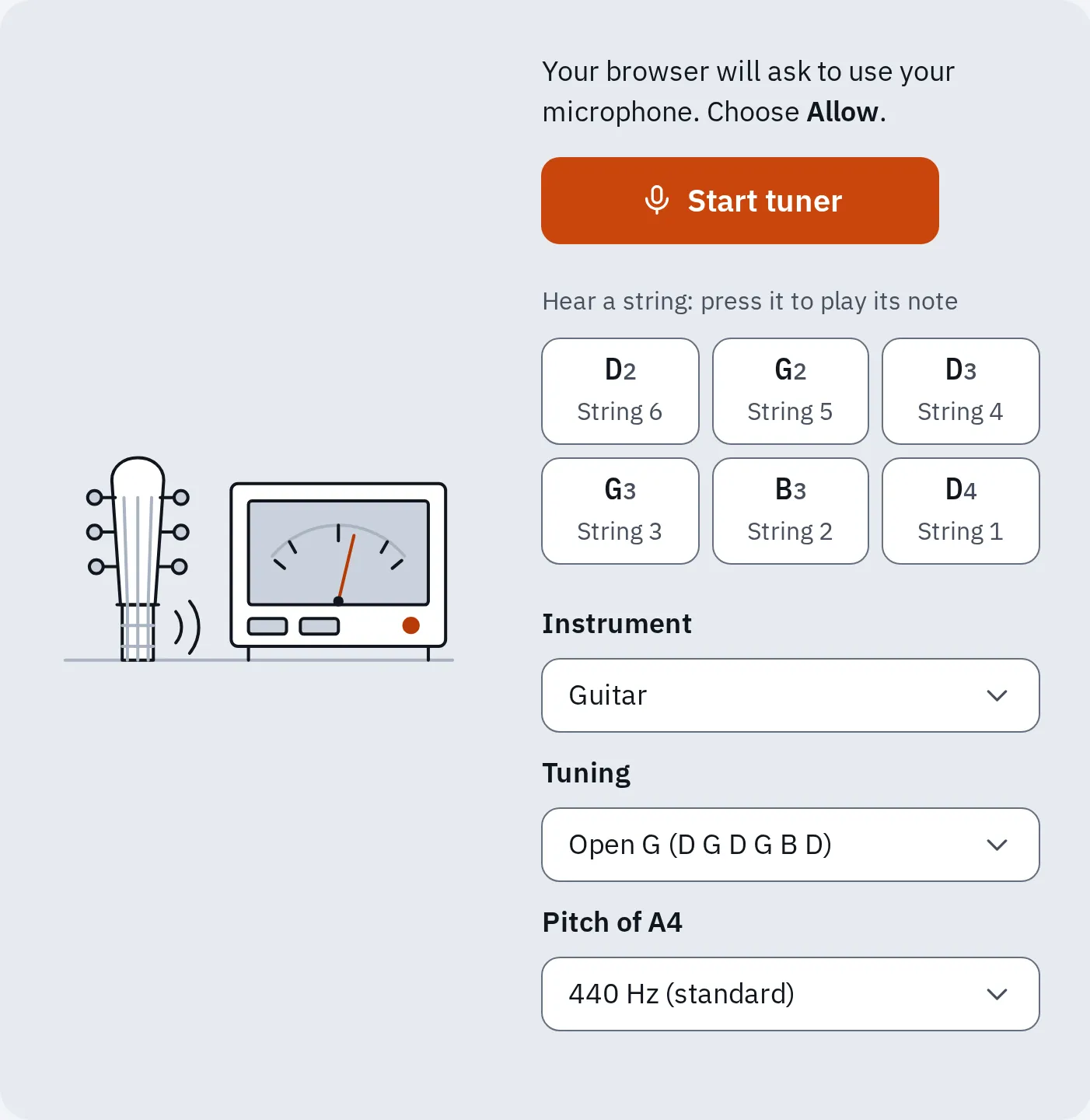
The guitar tuner opened with the open G link. The string buttons show the notes to tune to.
Test it now
Guitar tuner
The tuner compares each string you play with the nearest open G string. Check that the string number it shows is the one you played.
- Press Start tuner and choose Allow.
- Play a string you need to change. Check that the tuner shows the string number you played. If it shows another string, don’t follow its advice.
- Turn the peg a little at a time. Most of these tunings loosen strings, so the tuner says Too high at first.
- Went past the note? Loosen a little more, then tighten back up to it. A string holds its note better when you tune up to it.
- When every string says In tune, play them all once more. Changing several strings pulls the neck, so the first ones move a little.
The steps for standard tuning, and for tuning by ear, are in how to tune a guitar.
Why open tunings sound full
In an open tuning, the six open strings already make a chord. So you can strum without pressing any string. Lay one finger, or a slide, across all six strings, and you get the same kind of chord higher up.
- Open strings: G major in open G, D major in open D
- Slide over the 5th fret: C major in open G, G major in open D
- Slide over the 7th fret: D major in open G, A major in open D
In open G or open D, the open strings and a slide across them play the three main chords of the key.
Hold a slide right over the fret wire, not behind it as you would with a finger. At the 12th fret you get the open chord again, one octave higher.
Open D tuning
D A D F♯ A D. Strum the open strings and you hear a D major chord.
- Lower the 6th string from E to D (two frets down).
- Lower the 3rd string from G to F♯ (one fret down).
- Lower the 2nd string from B to A (two frets down).
- Lower the 1st string from E to D (two frets down). The 5th and 4th strings stay as they are.
Tune to open D with the tuner. Only the 3rd string differs from DADGAD: open D uses F♯, DADGAD uses G.
Open G tuning
D G D G B D. The open strings make a G major chord. Lower the 6th, 5th and 1st strings by two frets. Their new notes are D, G and D.
Tune to open G with the tuner.
Keith Richards of the Rolling Stones plays open G on a guitar with five strings, without the low D. Honky Tonk Women, Brown Sugar and Start Me Up use it. To play those parts, tune to open G and leave out the 6th string.
DADGAD tuning
D A D G A D. Lower the 6th, 2nd and 1st strings by two frets. Their new notes are D, A and D.
Tune to DADGAD with the tuner.
The open strings hold D, G and A, with no F or F♯. That makes a “suspended” chord, so it sounds neither happy (major) nor sad (minor) until you add the missing note. The open strings can ring on under the tune, as in folk music from Ireland and Scotland.
- British folk guitarist Davey Graham made it popular.
- Jimmy Page of Led Zeppelin used it for Kashmir and Black Mountain Side.
Half step down (E flat) tuning
E♭ A♭ D♭ G♭ B♭ E♭. Lower all six strings by one fret. Every chord shape stays the same; everything only sounds a half step (one fret) lower. Jimi Hendrix is among the guitarists known for this tuning.
Tune half a step down with the tuner. A bass has its own preset: bass, half step down.
Open E and open C
Open E (E B E G♯ B E) makes an E major chord. Open E raises three strings. Raise the 5th and 4th strings two frets, and the 3rd string one fret. Wikipedia’s list of tunings advises light strings for this reason. Open E has the same shapes as open D, two frets higher. So you can also tune to open D and put a capo on the 2nd fret.
Open C (C G C G C E) makes a C major chord with a very low 6th string. Lower the 6th string four frets to C. Lower the 5th and 4th strings two frets. Raise the 2nd string one fret, from B to C.
Open E in the tuner · Open C in the tuner
12-string guitar tuning
A 12-string guitar has six pairs of strings. Each pair is tuned like one string of a 6-string guitar. On the four thick pairs, the partner string sounds one octave higher. On the B and E pairs, both strings play the same note.
| Pair | Main string | Partner string |
|---|---|---|
| 6th | E2 | E3, an octave higher |
| 5th | A2 | A3, an octave higher |
| 4th | D3 | D4, an octave higher |
| 3rd | G3 | G4, an octave higher |
| 2nd | B3 | B3, the same note |
| 1st | E4 | E4, the same note |
Partner strings of a 12-string
Test it now
Online tuner
This tuner shows the note it hears and its octave number, so you can check each string against the table.
- Open the online tuner. Press Start tuner and choose Allow.
- Play one string of a pair at a time. Hold the other one still with a finger.
- Tune the main string of each pair: E2, A2, D3, G3, B3, E4.
- Tune each partner string: E3, A3, D4, G4, then B3 and E4.
- Play each pair together. If you hear a slow wobble, the two strings are not quite in tune. Turn the partner string slowly until the wobble stops.
- Go round all twelve strings once more. Twelve strings pull hard on the neck, so the first ones move while you tune the rest.
Questions people ask
Do I need different strings for these tunings?
You can often keep your strings for small changes, such as half step down or open G. Before bigger changes, such as drop C, check your guitar maker’s advice. For open E, check which strings the maker suggests. Or tune to open D and put a capo on the 2nd fret. On a floating bridge, each string you change pulls the others. Tune them all again until nothing moves.
How do I go back to standard tuning?
Open the guitar tuner in standard tuning and tune each string to E2 A2 D3 G3 B3 E4. Tighten the strings you lowered, and loosen the ones you raised.
Coming back from open G, open D, DADGAD, D standard or drop C? Tune the 1st and 2nd strings with the online tuner first, to E4 and B3. Our guitar tuner can read a 1st string at D4 as the D string, and a 2nd string at A3 as the A string, and call them in tune. From open C or drop C, the low C shows as a note, not a string: tighten it until the tuner shows E. Then check all six strings once more.
What is the difference between open D and DADGAD?
Only the 3rd string. In open D it is F♯, so the open strings make a D major chord. In DADGAD it is G, so the chord is neither major nor minor.
What is 432 Hz tuning?
It sets the A above middle C to 432 Hz instead of the usual 440 Hz. Every string ends up a little lower, about a third of a fret. Open the guitar tuner set to 432 Hz if your band asks for it.
Can I tune a bass to these tunings?
Our bass tuner has Drop D and half step down, plus 5- and 6-string basses. For Drop D on a guitar, see the Drop D guide.