Short answer
In a study of 168,000 volunteers, typing on a computer averaged 52 words per minute (WPM). On a phone, 37,000 volunteers averaged 36 WPM. US federal typing jobs ask for 40 WPM. The fastest 10% on a computer typed about 78 WPM or more.
- Average on a computer (Dhakal et al. 2018)
- 52 WPM
- Average on a phone (Palin et al. 2019)
- 36 WPM
- Where the fastest 10% start, on a computer (Dhakal)
- 78 WPM
- US federal typing jobs (OPM)
- 40 WPM
Step 1: measure your speed
Test it now
Typing test
Type for 1 minute on the device you want to judge. The result is your speed on everyday words today. Type two or three rounds, because one round can be off.
Where your speed sits
Type your result below. The scale shows the two studies’ own figures; it doesn’t guess a ranking they didn’t publish.
Type your speed to see where it sits.
A computer keyboard Dhakal et al. 2018, 168,000 people
- About 26 WPM: 1 in 10 people typed slower.
- 52 WPM: the average.
- About 78 WPM: 1 in 10 people typed faster.
- The shaded part holds the middle 8 in 10 people.
A phone screen Palin et al. 2019, 37,000 people
- 36 WPM: the average.
- 44 WPM: 3 in 4 people typed slower.
The same figures:
| Figure | Computer keyboard | Phone screen |
|---|---|---|
| Slowest 10% typed under | about 26 WPM | not published |
| Average | 52 WPM | 36 WPM |
| Faster than 3 in 4 people | not published | 44 WPM |
| Fastest 10% typed over | about 78 WPM | not published |
| Fastest people | 120 WPM or more | over 80 WPM |
What the studies measured
Researchers at Aalto University in Finland led both studies. They used the same test on a typing-test website. Each person copied 15 short English sentences, as fast and as accurately as they could. Each sentence was timed from the first key press to the last.
| Computer study | Phone study | |
|---|---|---|
| Paper | Dhakal et al., CHI 2018 | Palin et al., MobileHCI 2019 |
| People | 168,960 volunteers | 37,370 volunteers |
| Who | Average age 24.5, 68% from the US, 72% had taken a typing course | Average age 24.1, 47% from the US |
| Average | 51.6 WPM | 36.2 WPM |
| Mistakes left in the text | 1.2% of characters | 2.3% of characters |
What WPM and accuracy mean
Words differ in length, so typing tests count every 5 characters, spaces included, as one word. “hello world “ is 12 characters, or 2.4 words.
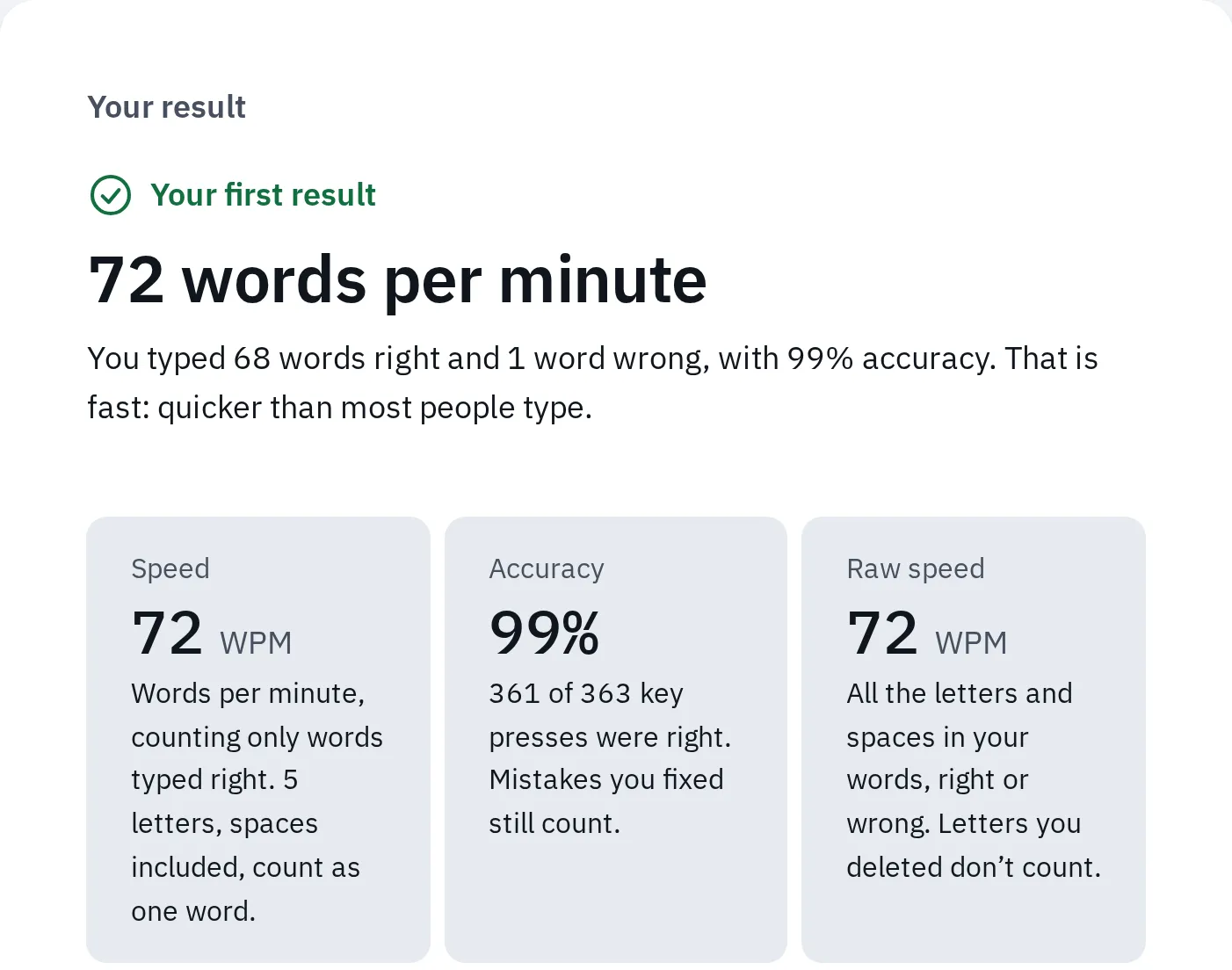
A 1-minute result in our typing test, typed by a test script with one wrong word. Speed and raw speed both show 72 WPM.
| Number | How our typing test works it out |
|---|---|
| Speed | Characters of the words you typed right, plus one space after each, divided by 5, per minute. 300 right characters in 1 minute = 60 WPM. |
| Raw speed | The same, but counting every character left in your words, right or wrong. |
| Accuracy | Right key presses out of all key presses. A mistake you fixed with Backspace still counts. |
The studies counted all the text people left, mistakes included, like our raw speed. So compare your raw speed for the closest match. The studies used short sentences, one at a time. A round of everyday words can come out a little different.
Is 40, 60, 80 or 100 WPM good?
Compared with the computer study (168,000 people, average 52 WPM):
| Your speed (WPM) | What it means |
|---|---|
| 25 | Among the slowest 10% in the study |
| 40 | Under the study average. US federal typing jobs ask for this much. |
| 52 | The study average |
| 60–70 | Above average |
| 80 | In the fastest 10% (about 78 WPM and up) |
| 100 or more | Well inside the fastest 10%. The fastest people in the study passed 120 WPM. |
On a phone, 36 WPM was average, and 44 WPM was faster than 3 in 4 people. Compare phone results with phone results only.
Typing speed for a job
The US Office of Personnel Management (OPM) asks for 40 WPM for clerk-typist and office automation jobs. It’s measured over 5 minutes with 3 mistakes or fewer (OPM standard). Data transcriber jobs there ask for 20 to 25 WPM. Other employers set their own levels, so check the job advert.
To practise for a job test, choose 5 minutes in the typing test and keep an eye on accuracy.
What makes fast typists fast
The computer study compared the fastest 10% with the slowest 10%. Three things stood out.
- One key at a time: each key comes up before the next goes down.
- Rollover: the next key goes down while the last one is still held (orange). The same keys are done sooner.
- Rollover. Most fast typists pressed the next key before letting go of the last one, for 40–70% of their key presses. Slow typists hardly did it. It was one of the strongest signs of a fast typist in the study.
- Fewer corrections. The fastest 10% pressed Backspace or Delete for 3.4% of their key presses, the slowest 10% for 9.1%. Fixing a mistake takes time: you spot it, delete it and type it again.
- More fingers, but not only that. The fastest typists said they used 8.4 fingers on average, the slowest 5.3. People who had taken a typing course averaged 54 WPM, against 49 WPM without one. That doesn’t prove the course made the gap. A smaller lab study found that some self-taught typists who used fewer fingers were as fast as touch typists.
On a phone, people who typed with two thumbs averaged 38 WPM, against 29 WPM with one finger. People whose phone autocorrected words were faster (43 WPM on average). Those who picked words from the suggestion bar were slower. The study can’t say which causes which.
How to type faster
The studies didn’t test ways to train. These steps follow our typing practice, which asks for accuracy before it opens the next lesson. For the full method, see how to type faster.
- Learn where the keys are without looking. Start the typing practice at lesson 1, the home row. Each lesson opens the next when you type it with 90% accuracy.
- Go for accuracy, not speed. Slow down until you rarely need Backspace. In the study, fewer corrections went with a faster speed.
- Practise your weak keys. After a test, read Keys you missed most. The typing practice has a round for your weak keys.
- Test again on the same setting. Use the same length and the same keyboard each time, so the numbers compare.
Do letters appear twice, or not at all, when you’re sure you pressed the key? Then the keyboard may be the cause. Check it in the keyboard tester, or see what to do when a keyboard isn’t working.
Questions people ask
Is 70 WPM good?
Yes. It’s well above the 52 WPM average of the computer study. The fastest 10% typed about 78 WPM or more. On a phone, 70 WPM would be very fast: the fastest people in the phone study passed 80 WPM.
How many words per minute does the average person type?
In a study of 168,000 volunteers, the average on a computer was 52 WPM. On a phone, 37,000 volunteers averaged 36 WPM. They chose to take a typing test and were mostly young, so the figures may not match all adults.
What is the fastest typing speed?
In the computer study of 168,000 people, the fastest typed 120 WPM or more. On a phone, the fastest of 37,000 people passed 80 WPM.
Why am I slower on a phone?
People left twice as many mistakes in the text on a phone as on a computer. The study’s authors suggest fixing mistakes is harder on a phone. Typing with two thumbs was fastest, at 38 WPM on average.
Does a typing course make you faster?
The studies can only show a link, not the cause. On a computer, people who had taken a course averaged 54 WPM, against 49 WPM without one. On a phone, they were slightly slower: 35.7 against 36.4 WPM.