Warning: This is not a medical test
This page explains color blindness. It can’t tell you whether you have it. An eye doctor or optometrist can test your color vision properly. If your color vision changes, or one eye sees colors differently from the other, make an appointment. If your vision changes suddenly, get medical help the same day. If you suddenly can’t see from one or both eyes, call your emergency number (such as 911 or 999) now.
Short answer
Most color blind people see plenty of colors, but mix up some of them, most often reds, greens and browns. About 1 in 12 men and 1 in 200 women of Northern European descent have red-green color blindness. It’s usually passed down on the X chromosome, which is why men get it far more often. There is no cure for the inherited kind; special glasses help some people tell colors apart, but they don’t restore normal color vision.
- Men of Northern European descent with red-green color blindness
- 1 in 12
- Women of Northern European descent with red-green color blindness
- 1 in 200
- Blue-yellow color blindness affects fewer people than this
- 1 in 10,000
- People with achromatopsia, which takes away most or all color vision
- 1 in 30,000
Red-green color blindness is less common in many other groups. In a review of studies, it affected about 8% of European men and 4 to 6.5% of Chinese and Japanese men (Birch, 2012).
Step 1: check how you see colors
Test it now
Color blind test
Your result shows whether your answers on its screen plates fit typical color vision or a color difference, as a first check, not a diagnosis.
What color blind people see
Color blindness comes from the cone cells in the eye. Most people have three kinds, for red, green and blue light. When one kind works differently or is missing, some colors look alike.
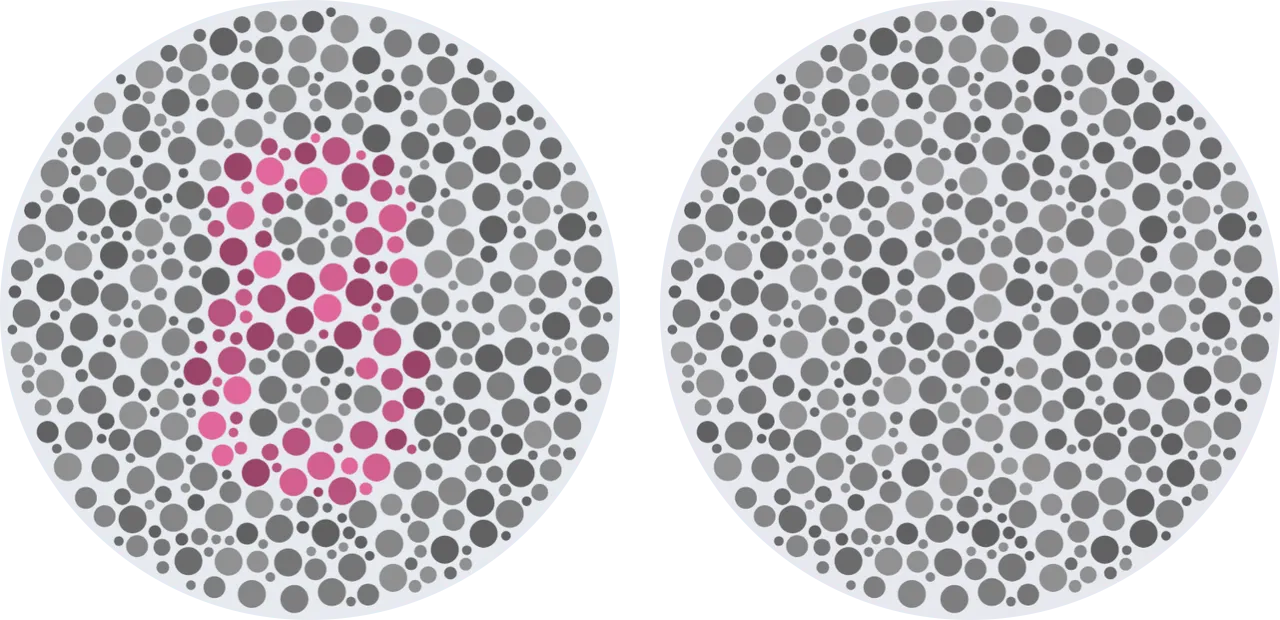
Left: a red-green plate from our color blind test. Right: the same plate in a computer simulation of deuteranopia (green cones not working). The 8 disappears.
The strips below show eight colors, and how they look in a simulation of each type where one kind of cone doesn’t work.
The same colors, simulated for each type
Typical color vision
- Red
- Orange
- Yellow
- Green
- Blue
- Purple
- Pink
- Brown
Red cones not working (protanopia)
- Red
- Orange
- Yellow
- Green
- Blue
- Purple
- Pink
- Brown
Green cones not working (deuteranopia)
- Red
- Orange
- Yellow
- Green
- Blue
- Purple
- Pink
- Brown
Blue cones not working (tritanopia)
- Red
- Orange
- Yellow
- Green
- Blue
- Purple
- Pink
- Brown
To see your own photo, chart or slide this way, open it in our color blind simulator.
The National Eye Institute describes what each type mixes up:
| Type | What happens | Colors that look alike |
|---|---|---|
| Deuteranomaly | Green cones work differently. The most common type. | Some greens look more red. |
| Protanomaly | Red cones work differently. | Some reds look more green and less bright. |
| Protanopia and deuteranopia | Red or green cones don’t work. | Red and green look alike. |
| Tritanomaly | Blue cones work differently. Rare. | Blue and green, yellow and red. |
| Tritanopia | Blue cones don’t work. Rare. | Blue and green, purple and red, yellow and pink. Colors also look less bright. |
| Complete color blindness | Very rare. | No colors, or almost none. Depending on the type, also trouble seeing clearly and more sensitivity to light. |
Who gets it, and can women be color blind?
Yes, women can be color blind, but it’s much rarer. The genes for the red and green cones sit on the X chromosome. Men have one X chromosome, so one changed copy is enough. Women have two, so they need the change on both (MedlinePlus Genetics).
- The mother carries the change on one X. She usually sees colors normally.
- The father has typical color vision.
- Each daughter gets one X from each parent. Half the time she is a carrier, like her mother.
- Each son gets his X from his mother. Each son has a 1 in 2 chance of being color blind.
How red-green color blindness is usually passed on. The orange X carries the change.
- A father with red-green color blindness passes the changed X to every daughter. Her color vision also depends on the X she gets from her mother. He can’t pass it to his sons, because they get his Y chromosome (MedlinePlus).
- A daughter is color blind when she gets the change from both parents: usually a color blind father and a mother who carries it.
- Inherited blue-yellow color blindness comes from a gene on chromosome 7, not the X, so it affects men and women alike (MedlinePlus Genetics).
When color vision changes later in life
Color blindness you are born with usually stays the same. Color vision can also change later, from:
- eye diseases such as glaucoma, macular degeneration and cataracts
- other conditions, such as diabetes, multiple sclerosis or Alzheimer’s disease
- some medicines, such as hydroxychloroquine (Plaquenil)
- getting older
Sources: National Eye Institute, NHS, American Academy of Ophthalmology.
Do color blind glasses work?
Glasses such as EnChroma use filters that block thin bands of light where the red and green cones overlap. That can make some colors stand out more from each other.
What they can do
Some people
The American Academy of Ophthalmology says they may help people with milder red-green color blindness see more contrast between colors. In one small study, after two weeks of wear, people’s measured response to color contrast was stronger, even with the glasses off (Werner et al., 2020).
What they can't do
Everyone
They don’t restore normal color vision or show new colors. In a 2018 study, they didn’t improve scores on color vision tests (Gómez-Robledo et al., 2018). They don’t help people with no red or green cones, and they may make it harder to see at night.
EnChroma itself says its glasses are for people with milder red-green color blindness, which it estimates is 4 in 5 cases. It says people with protanopia, deuteranopia or blue-yellow color blindness won’t see results.
Price: the Cleveland Clinic puts them at about $100 to $400 or more. In November 2026, EnChroma’s adult glasses cost about $150 to $400, and prescription glasses up to about $600. We don’t sell or recommend any glasses. Talk to an eye doctor before you buy.
Living with color blindness
- Phones and computers have color filters that shift colors you mix up. On an iPhone, open Settings Accessibility Display and Text Size Color Filters. The color blind test lists where to find them on Android, Windows and Mac.
- Some jobs test color vision, such as pilot and train driver (NHS). In the US, pilots who fail the FAA’s color test can be limited to flying in daylight (FAA). Ask the employer which test they use.
- Tell teachers if your child is color blind. Color-coded worksheets and charts can be hard to read.
Getting tested
An eye doctor or optometrist can test your color vision, often in a few minutes. The most common test is the Ishihara test: numbers hidden in dot plates, printed in a book (AAO). Some tests ask you to put colored caps in order. Ask for a color vision test, because it isn’t always part of a routine eye exam: in the UK it isn’t part of the NHS eye test.
Our color blind test uses its own number plates on your screen. It’s a useful first check, but screens and room light change colors, so it can’t replace a test by an eye doctor or optometrist.
Questions people ask
Can color blindness be cured?
Not the kind you are born with. Gene therapy gave color-blind squirrel monkeys full color vision in a 2009 study (Mancuso et al.), but it hasn’t been tested in people with red-green color blindness. If an illness or medicine caused the change, treating the cause may help: ask an eye doctor.
Is color blindness a disability?
In Great Britain, government guidance gives “simple inability to distinguish between red and green” with no other effect as an example that usually wouldn’t count under the Equality Act. It can still count if its effect on daily life is more than minor and lasts at least 12 months. Rules differ between countries, so check where you live.
Do color blind people see in black and white?
Almost never. Most see many colors and mix up only some. Achromatopsia, which affects about 1 in 30,000 people, takes away most or all color vision. Some people with it still see a little color.
What percentage of men are color blind?
About 8% of men of Northern European descent, or 1 in 12, have red-green color blindness. It is lower in many other groups, for example 4 to 6.5% of Chinese and Japanese men.