Short answer
Young adults with healthy ears hear from about 20 Hz, a deep rumble, to about 20,000 Hz, a very high whistle. The top end falls as you get older. In one clinic study, half the ears of people aged 21 to 30 heard 20,000 Hz. None of the ears aged 51 to 70 did (Wang et al.). Most speech sounds sit far lower, between 250 and 4,000 Hz.
Warning: This is not a medical test
This page explains hearing range. It can’t test your hearing or tell you if it is normal. If you think your hearing has got worse, see a doctor or an audiologist (a hearing specialist). If you suddenly lose hearing in one or both ears, get medical help straight away.
- Below about this, a tone stops sounding like a tone (Møller and Pedersen)
- 20 Hz
- Young healthy adults hear tones up to at least this (Motlagh Zadeh et al.)
- 20,000 Hz
- Where most speech sounds sit (ASHA)
- 250–4,000 Hz
The hearing range at a glance
Pitch is counted in hertz (Hz): how many times a sound vibrates each second. A low number is a deep sound, and a high number is a high sound.
- A piano in standard tuning: its lowest note is 27.5 Hz and its top note 4,186 Hz.
- Most speech sounds: 250 to 4,000 Hz (ASHA).
- A standard hearing test at a clinic: tones from 125 to 8,000 Hz (ASHA).
- Low-frequency sound: 20 to 200 Hz, deep bass and rumble (Møller and Pedersen).
- Very high pitches, above 8,000 Hz: they get harder to hear with age (Wang et al.).
Pitch from 20 Hz on the left to 20,000 Hz on the right. Each long tick is ten times the one before: 20, 200, 2,000 and 20,000 Hz.
| Sound | Examples |
|---|---|
| Low pitch | A tuba note, a large dog barking, the “oo” in “who” |
| High pitch | A bird chirping, a baby crying, the “s” in “sun” |
Hearing has no hard edges. A very loud sound below 20 Hz can still be heard or felt. But it no longer sounds like a tone (Møller and Pedersen). At the top, the highest pitches fade out over a range of pitches, not at one exact number.
How the top end changes with age
The highest pitches are the first to go, slowly, through adult life. When age-related changes become hearing loss, doctors call it presbycusis. In the US, about 1 in 3 people aged 65 to 74 has hearing loss. Nearly half of those over 75 have trouble hearing (NIDCD).
One clinic study tested 162 healthy adults aged 21 to 70 in China. All had normal hearing up to 2,000 Hz on a standard test, and no history of loud noise. This is the share of their ears that heard each high pitch:
| Age | 12,500 Hz | 14,000 Hz | 16,000 Hz | 18,000 Hz | 20,000 Hz |
|---|---|---|---|---|---|
| 21–30 | 100% | 100% | 100% | 78% | 52% |
| 31–40 | 100% | 96% | 64% | 20% | 8% |
| 41–50 | 93% | 80% | 39% | 2% | 2% |
| 51–60 | 82% | 59% | 31% | 3% | 0% |
| 61–70 | 74% | 45% | 16% | 0% | 0% |
Source: Wang et al. 2021, Table 2, rounded. Every ear in every group heard 8,000 Hz, and all but a few in the oldest group heard 10,000 Hz.
How to read it:
- It is a share of ears, not a cut-off. People of the same age differ a lot. Don’t look up your age and expect one number.
- The clinic turned the tones up. Each tone was made louder until the person heard it, through special clinic earphones. Our tone steps below play one fixed, quiet level. So you can’t compare your result directly with this table.
- It is one group. These were selected healthy adults, not a chart of normal hearing for everyone.
- It can start early. Another study tested 116 adults, most of them young, with normal standard tests. 74 of them had some hearing loss above 8,000 Hz. Those with more of this loss were more likely to say they struggle in noisy places (Motlagh Zadeh et al. 2019).
- There were no children or teenagers. The study had no one under 21. If you are worried about a child’s hearing, talk to a GP or doctor.
Standard hearing tests at a clinic stop at 8,000 Hz, so the top end is rarely checked (ASHA). Missing the top tones is common with age. What matters most day to day is following speech: see the signs of hearing loss below.
Try it: step through the tones
Use headphones if you can. Phone speakers and many laptop speakers may not play the highest tones, and can’t play the deepest ones. So a “can’t hear it” may be the speaker, not your ears. For how deep your speakers go, see what a subwoofer adds. If you have ringing in your ears, it can be hard to tell a tone from the ringing. Skip the test if it is.
First, play this middle tone. Set your device volume so it is quiet but clear, then leave the volume alone.
- 8,000
- 10,000
- 12,000
- 14,000
- 15,000
- 16,000
- 17,000
- 18,000
- 19,000
- 20,000
8,000 Hz
The high tones go up from 8,000 Hz: 10,000, 12,000, 14,000, then every 1,000 Hz to 20,000 Hz. Each plays as six short beeps. The low tones go down from 200 Hz to 100, 60, 40, 30 and 20 Hz. Each plays as one steady 4-second tone. The widget never makes a tone louder than the 1,000 Hz tone. Your headphones may still play some pitches much quieter.
Why a browser can’t test the whole range
A tone passes through several things before it reaches you. Any of them can stop it.
- The browser builds each tone from tiny slices of sound, often 44,100 or 48,000 a second. It can only make pitches up to half that rate (W3C): 22,050 or 24,000 Hz.
- The connection. Some Bluetooth connections cut the highest pitches. A headset in call mode carries only up to about 7,000 Hz, or less.
- Headphones bring the sound right to your ear, one side at a time. How they sit changes the high tones.
- A phone or laptop speaker is small. It plays little deep bass and may not play the top tones at all.
- Your ears come last. A "can't hear it" may be any step before them.
From the browser to your ear. A tone you can't hear may stop at any step.
A web page also can’t know how loud a tone is in your ear. Your volume, your headphones and the room all change it. A clinic uses calibrated equipment that knows. That is why we never call a result your hearing range or your “hearing age”.
Check each ear on its own
Test it now
Hearing test
It finds the highest pitch each ear hears through your headphones, but it can’t diagnose hearing loss.
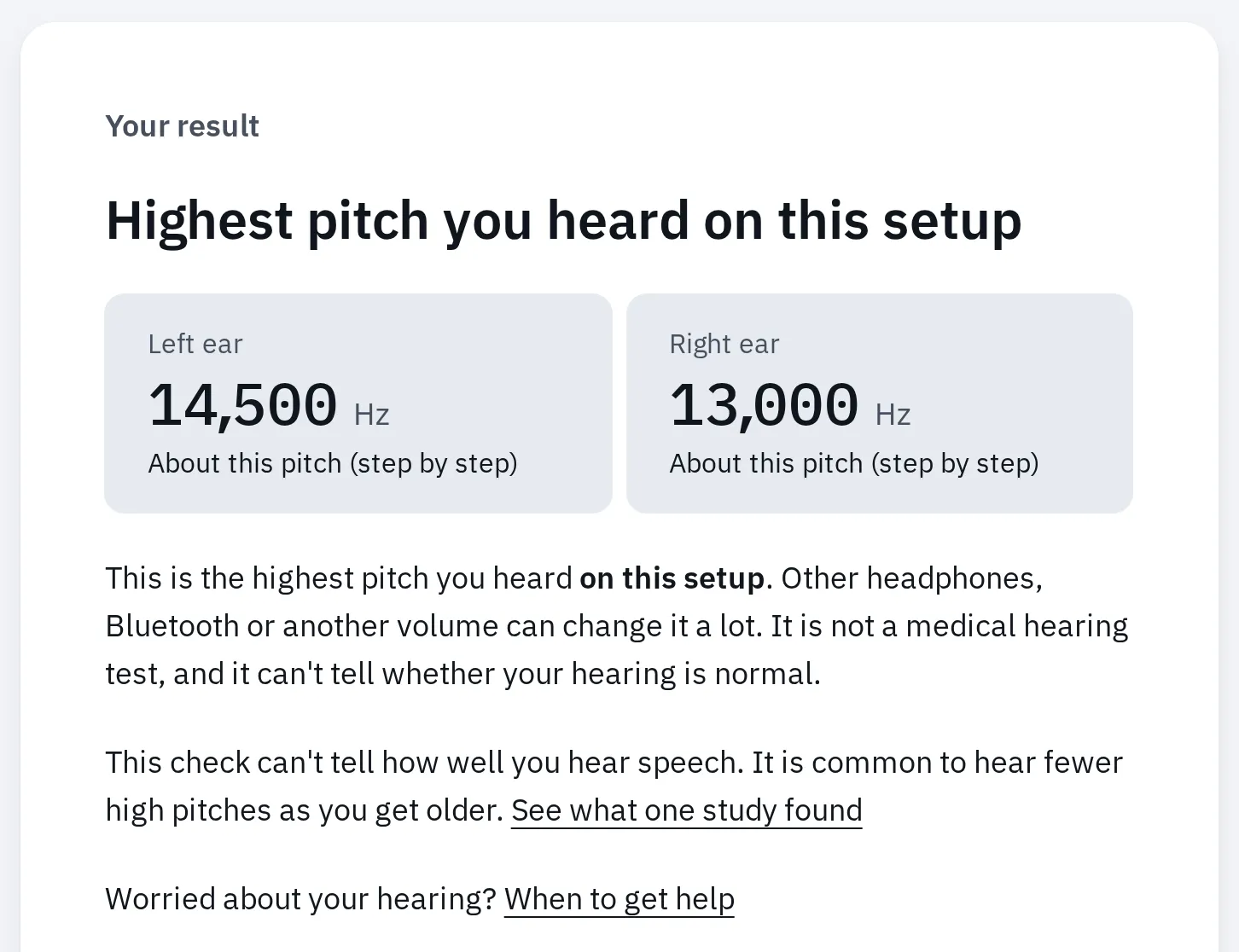
Our hearing test after the step-by-step check, answered by a test script. It shows a number for each ear, with no age and no verdict.
The hearing test sets the volume with the same 1,000 Hz tone and checks each side of your headphones. It also checks your answer once when no tone plays. To play one pitch for as long as you like, use the tone generator.
Protect your hearing from loud noise
Loudness is counted in decibels (dB). dBA is the same scale, weighted the way ears hear. Scientists don’t yet know how to prevent age-related hearing loss, but you can protect your ears from noise (NIDCD).
- 85 dBA or more, for long or often, can cause hearing loss. Sounds of 70 dBA or less are unlikely to, even for a long time (NIDCD).
- Headphones at maximum volume can reach 94 to 110 dBA, as loud as a concert (NIDCD).
- Keep your device below 60% of its maximum volume. At 80 dB you can listen safely for up to 40 hours a week. At 90 dB, it is only 4 hours (WHO).
- Dull hearing after a loud event can go away after 16 to 48 hours. But the tiny hair cells in your inner ear don’t grow back once they are damaged (NIDCD). If your hearing suddenly drops, don’t wait: get medical help straight away.
The decibel chart shows how loud everyday sounds are.
When to get your hearing checked
Common signs of hearing loss, from the NHS:
- you often mishear people, especially in noisy places
- you ask people to repeat themselves
- you have the TV or music louder than other people need
- phone calls are hard to follow
- you feel tired from concentrating when you listen
If you think your hearing is slowly getting worse, see a GP (family doctor). If the loss is permanent, a specialist will often suggest hearing aids. They make sounds louder and clearer (NHS). For a free first check, the NHS points to the RNID online hearing check. WHO offers the free hearWHO app.
Go to A&E or call 999 in the UK (your emergency number elsewhere) if you have ringing in your ears after a head injury. Do the same if it comes with sudden hearing loss, weak face muscles or a spinning feeling (NHS).
Questions people ask
Can a tone test tell my hearing age?
No. People of the same age hear very different top pitches. Your headphones and volume change the number too. In the clinic study above, 52% of ears aged 21 to 30 heard 20,000 Hz. So about half of young ears didn’t (Wang et al.). A number from a web page can’t give an age.
Is it normal not to hear 16,000 Hz?
It is common. In the clinic study, about a third of ears aged 31 to 40 didn’t hear 16,000 Hz. Most ears aged 41 to 70 didn’t either (Wang et al.). But missing one tone can’t tell you whether your hearing is normal. If you find speech hard to follow, get your hearing checked, whatever a tone test says.
What is the mosquito tone?
A name for very high tones that many young people hear and many adults don’t. The table above shows why. At 18,000 Hz, 78% of ears aged 21 to 30 heard the tone, but 3% or fewer from age 41 (Wang et al.).
Can people hear below 20 Hz?
Only if the sound is very loud, and then it no longer sounds like a tone. You may feel it as pressure or a shaking instead (Møller and Pedersen).
Why do I hear a tone that isn't there?
Ringing, buzzing or hissing that doesn’t come from outside is called tinnitus. See a GP if you have it often, if it gets worse or if it bothers you (NHS). Stop the tones if they make it worse.